Showing posts with label Nature. Show all posts

Saturday, May 2, 2020

Marine Mammal Memories

MareCet, a Malaysian NGO focused on the research and conservation of marine mammals in Malaysian waters, has recently started a series of online lectures on their Facebook page with the release of weekly videos till the end of June and will only be up till July this year so go check the videos out while you can.

To date, two videos have been uploaded - the first as an introduction to marine mammals and the latest on marine mammal tales and traditional uses in cultures across the globe. I just completed the latter lecture and it certainly brought back memories of these unique organisms as seen in the wild over the past three decades of my existence on this blue planet.

(WARNING: Much digression ahead.)

My earliest memory of marine mammals is probably from when I was about 10 years old, maybe younger, on a family trip to Pulau Langkawi. I must have seen a pod of dolphins leaping in the horizon while on a boat trip around the island as my mom captured scenic images of the beautiful sea with the jumping dolphins as black dots on the photographs using a compact film camera without a zoom. I remember my mother describing the moment to my relatives using the photographs as a visual aid, "The dolphins are the 'boogers' on the photo!"

The next time I saw marine mammals in the wild was during my first semester as an undergraduate at University of Hawaii at Hilo in the fall of 2008. I volunteered for a semi-annual Hawaiian monk seal, Neomonachus schauinslandi, count and travelled to predetermined locations on the Big Island by car to spot this endemic pinniped (semi-aquatic carnivorous marine mammals like seals, sea lions, and walruses) for an island-wide (or was it a state-wide) study on its population size and individual migratory patterns. I got in a car with the small group I was placed in led by the super inspirational and damn cool Darren Roberts (fanboy-ing now; ask me why personally) headed north to places that I have forgotten the names of (one good reason to start journalling seriously) for this count. We finally made our one and only sighting of a Hawaiian monk seal at Kauhola Point (I only remembered this location because of the lighthouse). It was sunbathing on the rocky shoreline. I was reminded to adhere to federal laws and to maintain my distance from this animal as to not harass it and also to not get my face bit off by this strong, semi-aquatic, wild animal. It was super chill though, ignoring Darren's closer examination of the identification tag(s) on its tail for the report at the end of sighting effort. After this virgin sighting of the Hawaiian monk seal, I observed it a few more times with the most memorable sighting on a summer afternoon at Richardson's Beach Park where a huge individual made its way to a freshwater/brackish pond by the car park. Good times.

The lighthouse that helped me figure out the name of location where I sighted my first ever pinniped in the wild, the endemic Hawaiian monk seal. 
A digitally zoomed image of the Hawaiian monk seal basking on dry land.
I think I zoomed in for this photograph too. Look at the orange identification tag on its tail. I think there could be more tags on its tail, maybe even flippers, because I keep remembering seeing more than one tag. Maybe this memory is of a different individual some other time after this sighting.
The following semester in spring of 2009 (I think) while on a field trip out at sea for my Marine Biodiversity Laboratory class, I actually got to see and hear Humpback whales, Megaptera novaeangliae. This is towards the end of an annual affair of migrating from the icy cold waters of the northern seas to the warm tropical waters of the Hawaiian archipelago to mate along the way and give birth to young. I vaguely remember observing some partial breaches from a pod of a few individuals.What I do remember very well is the song of the Humpback whales captured from the hydrophone of the vessel - it was magical. Although only able to listen to a small segment before losing the signal, I remember feeling extremely calm and grateful for being able to be there with my classmates and instructor. Unfortunately, I do not have any visual (nor audio) records of this warm experience. Thanks, Humpback whales! Like the Hawaiian monk seal, I made few more sightings of these giants while in Hawaii.

Fast forward to the year 2015, I made sightings of dolphins from the shores of Datai bay where I used to work at The Datai Langkawi, a five-star luxury resort as an informal educator. These are Indo-Pacific humpback dolphins, Sousa chinensis. I have created a reputation at my former workplace for the person that all dolphin (or any other "cool") sightings must be reported to so we can contribute to MareCet's long-term research on Langkawi dolphins. I would request my then watersports colleague to take me out on the inflatable to capture images of their fins to assist MareCet in the possible identification of individuals visiting the bay but without much luck. My colleagues, resort guests, and I would get very excited to see these animals in our bay, it was always a very special treat. The "Old Guards" of the watersports pavilion at the resort always told me that the appearance of dolphins in our bay would ALWAYS usher stormy events in the very near future. Unfortunately, I never found this to be true since the islands' weather is determined by the monsoons.

The best that I can do from shore with the animal being more than 200 m away from me, a person with no prior experience commandeering an inflatable equipped with a then five-year old 200 m zoom lens.
I then got to learn more about this animal and other cetaceans (fully aquatic marine mammals like dolphins, porpoises, and whales) in September of the same year when I finally got the opportunity to participate on my first MareCet fieldwork as a volunteer in a study on population density of the Indo-Pacific humpback dolphin (and I think also the estuarine Irrawaddy dolphin, Orcaella brevirostris) of the coastal waters off of Matang Mangrove Forest in the state of Perak. Other than the aforementioned species of cetaceans, I also managed to observe the elusive (or is it evasive?) Indo-Pacific finless porpoise, Neophocaena phocaenoides, mostly reminding me of floating tyres. I got to see a group of young Malaysian "cetaceanists" (you read this here first) passionately (and patiently with a lot of discipline) go out on explorer boats with a local captain in search of cetaceans for eight days. It was an eye-opening experience. I learned a lot about the science that goes behind studying marine mammal ecology in Malaysia and also the character needed to dedicate so much of one's life in doing so. There were many profound personal experience for me throughout the eight days but the happiest, most fulfilling moment as a volunteer with MareCet over roughly four years (this is after considering the times when we buried a dolphin carcass above the high tide mark of a secluded beach along the obsolete part of Jalan Teluk Datai and sieving the guts of a dead porpoise after dinner into the early morning of the following day) would be on perhaps the third day of this particular trip when I managed to alert the team of a sighting of a Irrawaddy dolphin. This would be the first of the very few times I have alerted the group  of a marine mammal sighting, an achievement that I am still very proud of myself. (It is tough since it is quite easy to mistake a white cap of a the crest of a breaking wave as a dolphin's dorsal fin. Plus I have bad eyesight....)

Sometimes, local vessel owners would allow for the temporary installment of what I call the "umpire's seat" at the bow of an explorer boat as seen in this image. This seat can accommodate two primary observers, towering perhaps four to five metres above the waters in search of swimming cetaceans. Since the primary observers have a wide angle of view to focus on, a third observer when there are sufficient individuals onboard, would stand below the the seat to look a narrow angle of view (right ahead) to catch missed observations by the primary observers as they scan through their viewing field. I was the third observer when I called out my first ever alert. It was exhilarating! Pictured here from left to right is the fearless Vivian, jovial Sandra, and amazing photog Long. 

A pod of Indo-Pacific dolphins in the waters of Pulau Langkawi in November 2016. I think this is the first trip for Sandra's behavioural/social study on this species. Dolphin researchers like Vivian and Sandra require clear images of the dorsal fins of individual dolphins for identification. Think markings on dorsal fins as fingerprints for humans. I hear it is a tedious process trying to identify individuals like this but it has proven to be a very accurate, non-invasive way to doing so.
During my time as a Masters student in the Global Field Program offered by Miami University, I had the chance to travel to parts of the world that I would not have thought of to learn about inspiring conservation work and unique biodiversity on summer field trips known as Earth Expeditions. It is during these Earth Expeditions that I manage to see foreign marine mammals in the wild. Baja California is a magical place and our Sea of Cortez leg (at Bahia de Los Angeles) of my 2016 Earth Expeditions allowed me to see my next pinniped, the California sea lion, Zalophus californianus swimming in shallow waters. You can view a video of this sighting here. I was feeling a mix of excitement and anxiousness - excited because well, it is a cool animal that I have only previously seen in captivity and anxious because there was a huge male that swam quite close to us. I thought he was going to obliterate me!

The Sea of Cortez, or more commonly known as the Gulf of Mexico, is a deep sea due it being a rift from tectonic events off the North American Plate. Upwells in this see transport nutrient-rich waters from the cold deep sea, allowing microorganisms to thrive, creating the base of a food web capable of sustaining large organisms. While the boat carrying me and my classmates were out on "swelly" waters, I manage to catch a glimpse of a whale as the boat was travelling up the crest of the swell. It could have been either a Fin, Balaenoptera physalus, or a Bryde's whale, Balaenoptera brydei, from the size of the animal but we were not close enough to see discerning features so I cannot confirm the species. On different day out at sea, the entire class was lucky enough to observe a pod of Short-finned pilot whales (technically very large dolphins), Globicephala macrorhynchus, swimming very gently at the surface of the water. I remember being incredibly shocked and in awe of the size of the animals in this pod. There was one, I kid you not, that was the length of the boat we were on. I did not pack my DSLR on this particular Earth Expeditions, which I regret till this day (should not have packed the extra clothes), so I only have a few scenes using my GoPro Silver 4 which you can see at the beginning of this video of the non-Whale shark aquatic highlights of Sea of Cortez. (For the video on my first ever Whale shark experience, click here. The Whale shark, Rhincodon typus, is a large, filter-feeding cartilaginous fish.)

My final Earth Expeditions was to Belize in 2017. The class was out on the boat travelling in the calm coastal waters of Belize within the largest barrier reef in the western hemisphere in search of Antillean manatees, Trichechus manatus, with Belize's Manateeman, Jamal Galves, a local Belizean dedicated to the conservation of these gentle giants. When we approached an estuary at the mouth of a mangrove river, someone pointed out manatees in murky waters. This is perhaps the cutest marine mammal sighting yet for me. Even though I did not get the see the general form of the Antillean manatee due to murky waters, my classmates and I got to see the "snoots" of manatees coming up to to breathe dry air. Sirenians, the group of marine mammals like the Dugong and manatees, are related to elephants! The snout of the manatee poking out from the water for dry air reminds me of how elephants would use their trunks as snorkels when travelling in water! The snouts of sirenians are also prehensile like the trunks of elephants. My heart was leaping in excitement when I saw the manatees. Not what I expected to experience (think clear waters with tens of manatees surrounding the boat or clear waters where one can easily watch a manatee graze on seagrass from the surface), but a special experience nevertheless which I am grateful for.

The emerging snouts of a mother-calf pair (mom on the right, calf on the left). So cute!
If you watched MareCet's first video in their online lecture series, you would have learned of the different types of marine mammals. Three were mentioned here, cetacean, pinniped, and sirenian. The other would be marine "fissiped", apparently a defunct term to refer to carnivorous mammals who are fully reliant on the ocean for sustenance and reproduction. This includes the Polar bear, Ursus maritimus, and "ocean" otters like the Sea otter, Enhydra lutris. I have yet to see these species in the wild. In addition to this, I have also never seen the Dugong nor the other cetaceans, like the Bryde's whale, present in Malaysian waters. I really hope I will get the chance to observe them in their natural habitat one day.

These animals are apex predators and/or keystone species in the ecosystems they are part of. Without them, ecosystems crumble and we risk livelihoods and the survival of humans globally, whether directly or indirectly. And of course, they have the intrinsic right of being alive as a species. Therefore, we must make change and do our part in conserving and preserving these species and their habitats. I urge you to voice out against irresponsible coastal development, demand for better/more transparent supply chain of seafood (or reduce in the consumption of aquatic species), fight against pollution of waterways, do not litter/reduce the generation of solid wastes in your household, and support responsible tourism (no speeding boats, no feeding of animals, and definitely no crowding around these charismatic animals - let them dictate your experience). 

Sunday, February 25, 2018

Flora of Earth Expeditions

Recently, my Global Field Program cohort got their Earth Expeditions placement for this year. It would have been my last Earth Expeditions with my classmates but I have already completed three of them after last year's trip to Belize. I am definitely going to miss this part of my life - travelling to a foreign place to learn about ecology and pedagogy, meeting amazing people, and experience moments that will inspire you for a very long time, if not forever!

I have observed many new things during my Earth Expeditions travels and there are many things to write about (if I had my journals with me, hah). But for this entry, I thought I could write about the plants that defined each of my Earth Expeditions. I am not a plant guy. However, having a mentor whose knowledge and passion about the natural world is so deep, I suppose the interest in plants (and birds) rubbed off on me.

For my first Earth Expeditions in 2014, I went to Townsville, Australia focused on coral reef ecosystems and how the Great Barrier Reef Marine Park Authority leads the conservation of the Great Barrier Reef. I signed up for this course for the masters credits to try things out. The class brought us to different locations and habitats. I am so glad to have seen Eucalyptus trees in its native habitat. What took the cake is seeing Koalas in the wild on the Eucalyptus trees on a leisurely, guided stroll on Magnetic Island. It felt so unreal to see teddy bear-like creatures on trees in real life! Plus, the Koalas were on trees in people's yards! GUYS. KOALAS. IN PEOPLE'S YARDS. SO CUTE.
A tall Eucalyptus tree.
Big Eucalpytus trees in a Eucalyptus forest.
Boo!


SO ADORABLE!
THE BABY IS LOOKING AT ME! AHHHHHHHHHHHHHHH!
Two years later, I decided to enroll into the Program and embarked on my second Earth Expeditions to Baja California, Mexico. I was pleasantly surprised of how green the desert system in Baja California is. I thought that all deserts are void of life. I am just super disappointed that nobody has come up with the name "Cardon" forest or at least cacti forest to describe the landscape of Baja California. Everything was brand new to me but my favourite plant of Baja California has got to be the Cirio. It is also known as the Boojum tree and its weird growth often became the subject for scary folk-esque stories. My instructor described the Cirio as being a tree with the tortured soul of an evil coloniser. (The desert at night can look very creepy. I felt like there should be some sort of myth or legend concerning the flora of the desert of Baja California.)

They grow very tall!
See. Cardon forest... Maybe Cirio forest?
Creepy... and beautiful.


Last year's Earth Expeditions to Belize introduced me to now my most favouritest symbiotic relationship of ants with Bullhorn Acacia. I know, I know. I loved the seagrass in Belize but the Bullhorn Acacia just has the most interesting story. The swollen "bullhorns" along its branches are actually hollow. On closer inspection, you can see a hole on the underside of the tip of the bullhorn. This hole is used by ants as their nest. The ant colony protects its host Bullhorn Acacia from herbivores and I personally think they are super effective since I got myself bitten TWICE while carrying out an inquiry exercise on how quick their reaction is to responding to a disturbance. My ring finger was swollen for three days and it was the most painful ant bite in my life. (I wonder if our body builds up immunity to ant bites over the years. The ants in Malaysia can deliver painful bites but gosh, the ants in Belize bit like hell!) The colony of ants are attracted and "paid" by the Bullhorn Acacia with supplies of carbohydrates and proteins and lipids. There are glands on the underside at the base of the leaves that produce nectar full of carbohydrates and nodules on the tips of the leaves that are rich in protein and lipids called Beltian bodies.

I sadly only have one picture of this plant. I regret not visually documenting this plant more extensively.
These are just a few of the plant species I am blessed to have come across during my Earth Expeditions. While I may be done with Earth Expeditions, I think I will continue to learn more about plants in the future. There are so many species to be acquainted with locally and I hope my future travels around the world will introduce me to new plants.

Sunday, October 9, 2016

So Green.

I have been meaning to write an entry about my Earth Expeditions trip to Baja California, Mexico in July but have managed to procrastinate writing about one of my best life/travel experience for THREE MONTHS! I know, I be lazy. I also blame less than favourable internet connection speed and longevity and having to actually blog for work; basically typical master procrastinator excuses.
I learned a lot from my experience on the Australia EE in 2014; from learning about Great Barrier Reef ecology to the clouded rainforest of Paluma Range National Park, and being exposed for the first time to community-based conservation and inquiry-based learning. I think my favourite part of the trip was learning about and from the Nywaigi people of Australia at Mungalla Station. This picture is of the wetland restoration project the Cassady family has done at Mungalla Station.
Earlier this year, I got accepted and enrolled myself into a Masters program with Miami University called the Global Field Program (GFP), a program very suitable (but not limited) for educators of all fields (schools, museums, zoos, aquaria, and etc.) interested in conservation and inquiry-based learning. The major attraction of the GFP is its summer Earth Expeditions (EE); a way to travel and earn credits for your graduate studies, for personal development for potential career advancement, or personal development for simply your own personal development.

Not wanting to commit fully to pursuing a Masters degree previously, I enrolled into the Australia EE in 2014 as a standalone class just for the seven graduate credits after reading about EE courses sent to the University of Hawaii at Hilo Marine Science Department's listserv (which I still check once in awhile for any career or graduate studies opportunities). Needless to say, I had a wonderful time and somewhat enjoyed the lessons then. (Evidence of me enjoying my Australia EE trip: 1, 2, and 3.)

Since leaving my job at a milk packing facility in the end of 2014 and starting my amazing job in Pulau Langkawi, why not do graduate school while working? The GFP is very compatible to my current job in education and outreach and conservation science. So I gave it a go.

My first GFP class is a summer EE to Baja California. Initially, I was slightly disappointed in being placed into this EE. Because even though learning and experiencing the pelagic ecosystem of the Sea of Cortez would be amazing, I was not too keen to learn about the desert of Baja California. Why should I learn about the desert when I live and work in a tropical rainforest?! Even the text I had to read about the desert flora of Baja California is a boring and dry read. (Pun intended; I will show myself out.)

It was not until the long (but fun) drive (it turned out to be a roadtrip) into the desert on our way to Rancho San Gregorio did I realise how alive the desert of Baja California can be. I was seeing GREEN along Highway 1, a sight I would never have expected in a desert, even after reading about it.

I expected the desert to be more like this. Photo credit.
Instead, I got views of lushness like this. Photo taken close to Catavina Town.
And this. Just look at how green the valley is! There are even visible green patches on the hill. Shameless selfie taken on a hike to view Cochimi cave paintings.
I am also glad to have classmates who know a lot about desert flora, pointing out the different types of plants we come across. I especially enjoyed learning about the desert from Rafael Villavicencio, the "chief" of Rancho San Gregorio. (Rafael is a computer guy turned traditional healer. He reminds me very much of Dr. Ghani, medical doctor practicing traditional Malay medicine in Langkawi.) Life is tough in the desert of Baja California but it provides for the survival of many generations of people and animals. It provides enough.

Rafael conducting an ethnobotany walk for the class. In this picture, I think Rafael was explaining about the palo verde tree, which is a source of food for horses and branches can be used to make tea.
Rafael explaining how the Villavicencio family has farmed in the desert for a long time. Behind him is a grape vine he or one of his relatives planted. The family has also planted date palm trees!
Fruits of the nopal (Opuntia cactus), also known as the "prickly pear". This is just one of the few examples of the sustenance provided by the desert. This fruit is surprisingly juicy, an apt snack after a walk in a 48 degrees Celsius desert with little to no clouds. The other parts of the nopal can also be eaten. We had a nopal salad on a couple of meals. Guys, I ate CACTUS.
I am still in awe of how alive a desert can look.

Another surprisingly place to have green is on a mostly barren volcanic island about 800km away from Rancho San Gregorio in the Sea of Cortez. The class got to check out the cutest mangrove forest ever here. The craziest part of it all is that there is no freshwater visible on the island, with little rainfall too, and then BOOM! (insert "Surprise mutha..." Dexter meme) A thriving mangrove forest relying on saltwater.

Beautiful.
See how cute these stunted mangroves look? It looks like a species of Rhizophora. I think the mangroves here are short because a lot of their energy are being used to desalinate the saltwater for freshwater for survival instead of growth in height. If this is true, what an amazing adaptability!
My Baja EE definitely reminded me that nature, or life, will find a way to survive and then thrive in the future. It is an inspiration to me as I continue being involved in conservation work in Malaysia.

This is just one of the few entries I am going to be writing about this EE. I am not sure when the next entry will be, but stay tuned? There are plenty yet to be shared. 

Thursday, June 23, 2016

Stairway to Granite Heaven.

Standing 881m above sea level, with visible radio towers sticking out on its peak from below, is Gunung ("mountain") Raya, the tallest mountain on Pulau Langkawi, I think the tallest also in the Langkawi archipelago. This is a granite mountain, and its intrusion in the late Triassic pushed Langkawi out of the water to become an island (I could be wrong about this, please correct me if I am wrong). Pulau Langkawi has a rich geological history and is a UNESCO Global Geopark, though not known to the majority, this designation actually covers the ENTIRE Langkawi archipelago, hence the reason why some people may now refer to this group of 99 islands (annoying ones will tell you it is 104 when the tide is low) as Langkawi Geopark.

Anyway, I used to live at the foothill of this mountain near a granite quarry (naturally) and have been to the top of Gunung Raya a handful of times as it is easily accessible by car since there is a really nice paved road (one lane for each direction) up to the peak where the radio towers sit with an old, but newly reopened tea house on top. The last time I drove up to the peak it was free, but a friend who visited Pulau Langkawi last week told me he had to pay a fee to drive up the mountain and he got a cup of tea at the tea house. So I am not sure if you can choose to not pay the fee or not.

It is a slight windy road and has little road hazards during the day, but night time please be extra careful. There are nocturnal creatures running and gliding about, like some species of civet "cats" which I ALMOST ran over a couple of times while travelling up and down the mountain at night. (I was not speeding, I promise!) Plus someone's herd of cows roaming along the road can be quite a fright while driving in the dark. During the day, you will be able to see different species of birds, which is a very big reason why birdwatchers and "twitchers" (the photographers of birds) love to visit Gunung Raya (duh!).

The view of Gunung Mat Cinchang (sometimes "Chincang", sometimes "Chinchang", sometimes "Cincang"), another peak on Pulau Langkawi where the cable car sits. I think this is Mat Cinchang, someone correct me if I am wrong, please.
Beware for wild pigs too!
That is Sungai (River) Kilim by Tanjung Rhu side in the background and me being a tourist in the foreground.
The view of Pantai Cenang or Kuah, I cannot make it out from Gunung Raya at night. Not much stargazing on Gunung Raya because of the orange streetlamps by the tea house and radio tower.
I personally like to go up Gunung Raya to enjoy the view and look at the hornbills. There are three species of hornbills on Pulau Langkawi, the Great hornbill (Buceros bicornis), the Oriental-pied hornbill (Anthracoceros albirotris), and the Wreathed hornbill (Rhyticeros undalatus), and you can find all three of them on Gunung Raya. I get to see the Great and Oriental-pied hornbills at my workplace, but not the Wreathed. And for a very long time, possibly only after 14 months of living on the island, I finally managed to catch a glimpse of a pair of Wreathed hornbills. When I took this photograph, it after I heard them "bark" in while driving down the mountain with my windows closed. Wish I had a larger lens.

A flying Great hornbill on Gunung Raya.
I had to stop in the middle of the road when I heard the call of the Wreathed hornbill to take this photo. This pair was wayyyyy up high so forgive me for the blur picture. The husband has a yellow gular pouch, while the wife has a blue one. Check out better photos in the Wikipedia entry.
A male Oriental-pied hornbill eating a fig from a strangler fig tree at workplace.
The resident Giant hornbill pair at my workplace on the same strangler fig tree as the Oriental-pied hornbill. The wife is in the top photo, while the husband is in the bottom photo. Beautiful pair!
Another more challenging way to get up the mountain is by walking. Yes, you read that right, WALKING. There is a staircase of 4,287 steps up to a viewing point, and then a few hundred more metres of walking on paved road to the peak from there. This staircase is called Tangga Helang Seribu Kenagan, in terrible direct translation would be "a thousand memories/experiences of eagle staircase" and the start of this staircase is located at Lubuk Semilang, "catfish hole" in another terrible Jonathan direct translation.

A part of the staircase to the top. Forgot which part. Haha.
The walk is amazing because the staircase is built to lead you to the top through the rainforest and the flora there is beautiful! Large dipterocarp trees and lianas. Some of the trees are labeled with common names, probably the good work done by legendary traditional Malay medicine practitioner, Dr. Ghani.

Not sure what tree is this in English. Sorry.
Possibly a type of meranti tree (Shorea sp.). Super tall and large!
Not much wildlife to see while walking along the staircase but I have seen some "flying" lizards (Draco sp.) resting well camouflaged on the tree trunks, some butterflies like the Malayan tree nymph (Idea hypermnestra) that looks like paper fluttering in the air, Great hornbills, and Jumping spiders (Salticidae). And if you are a fan of mushrooms, you will be able to see plenty of this fabulous fungi about. (Check out my Gunung Raya Staircase album here.)

Another well camouflaged animal, the flying lizard (Draco sp.). So many camouflaged animals! It is as if they do not want to be found! Oh... Right...
Camouflaged fungi.
This is a type of Lantern bug (Pyrops sp.). Very beautiful.
The first time I did this was with two friends. We walked up and down, then went for a nice dip in the creek/river at Lubuk Semilang at the end. It was quite scary because one of them almost fainted because of the lack of calories in the morning. (I asked them if they wanted to consume anything before but they declined. Noobs. Love them still.)

Sebastian and I. We completed the walk up and down in about three hours.
The creek at Lubuk Semilang. There are deeper spots to swim in, where we swam.
The second time I went up the staircase was for BDB's Triple Challenge Climb and Run event. I never joined a run before because I thought it is such a waste of money to pay to run on trails that you can normally do for free. But wow, my colleague who joined me on the run was right; once I start I am sure to do it again. I suppose it is because of the feeling of achievement at the end. But I digress...

The Climb and Run track started from Lubuk Semilang, then a run up the Eagle Staircase of Sweet Memories, before running down the mountain on the road, then a run on the main road back to Lubuk Semilang. I enjoyed this event. I thought it was well run (no pun intended). I had no problems going up the stairs (done in roughly 52 minutes) but the run down, gosh, painful. No problem on the run on the main road. I finished the event in two hours and 39 minutes, not bad for a newbie. (You can find the results of the event here.)

Me at the end waiting for my colleague. Selfie taken using my Nexus 6P.
Other than battling the pain from running downhill, I had to do some last moment maneuvers to evade funky looking caterpillars descending using their silk from the trees above the road! Not sure what lepidopteran this is yet, but my boss tells me it is a type of moth. I am still awaiting the answer from one of the authors of the photo guide book on Butterflies of Langkawi.

Here is the funky looking caterpillar. Some people are calling it "Trump" for its uncanny resemblance to Donald Trump's hairstyle!
Anyway, if you do visit Langkawi, check out this magnificent granite of a mountain to enjoy the rainforest and the view.

Sunday, March 13, 2016

Corals and Coral Reefs

I have recently launched a new interpretative walk at my workplace at the reef flat accessible by foot via the beach. So in preparation of the walk, I have done much reviewing on corals and coral reefs, and even learned new things along the way. And to help gather my thoughts for this reef flat walk, I thought I should share what corals and coral reefs are on this blog. Enjoy.

The anatomy of a coral polyp. This form of polyp is
known as a stationary polyp.
A reef is simply something located beneath the water's surface. A reef can be abiotic (not a living thing) ie. a ridge of rocks, submerged sandbanks, and shipwrecks, or biotic (living organism) ie. coral reefs. As the name suggests, coral reefs are made up of... CORALS! And yes, corals are living organisms.

Corals are marine invertebrates of the phylum Cnidaria, which sea jellies and sea anemones are part of too. Being cnidarians, corals also have stinging cells for feeding and defense purposes.

The coral head, which is what we see and enjoy on our snorkeling and SCUBA diving trips, and what creates a coral reef, is the colony/colonies of Scleractinian corals - corals that form calcium carbonate exoskeleton (aragonite) for protection. (And since the calcium carbonate exoskeleton is hard and sturdy, Scleractinians are commonly known as hard or stony corals.) Inside the coral exoskeleton are genetically identical individual coral polyps, the coral animal itself.

In Bahasa Malaysia, corals are known as Batu Karang, and "batu" means "rock/stone". I think some exclusive Bahasa Malaysia speakers may just think that corals are really just rocks and will definitely treat coral reefs differently compared to those who know the difference. Just something that conservationists should have in mind when working with local communities.

There are two types of hard corals: hermatypic corals and ahermatypic corals. Hermatypic corals are reef builders, the one that we are all most familiar with (and the corals focused in this entry), and ahermatypic corals are hard corals that do not form reefs.

Top: Some hermatypic brain corals (Mussidae?) and hump corals (Porites sp.?). Bottom: Some ahermatypic solitary mushroom corals (Fungiidae). Both photos taken in Datai bay, Langkawi.

 Another significant difference between hermatypic and ahermatypic corals are the presence of photosynthetic single-celled dinoflagellates, known as zooxanthellae, in hermatypic corals. The zooxanthellae (Symbiodinium) and corals have a mutualistic relationship (benefiting both parties) with each other, whereby corals play host and protect the zooxanthellae within the coral polyps and exoskeleton while excess food created from photosynthesis get transferred into the coral polyps' cells for metabolism, growth, and reproduction. And since the corals respire to produce carbon dioxide and water, the zooxanthellae also benefit from easy access of inorganic carbon and a reducing agent for photosynthesis (visit this page for an animation to easier understand what you just read and this and this pages to learn how corals acquire zooxanthellae). (Acquiring food from their endosymbionts are not the only way corals get food. Being cnidarians like sea jellies, corals have nematocysts as seen in the anatomy figure above, which can be used to stun their prey, like tiny fish, and digest them. But since the synergy between the corals and zooxanthellae is so efficient in most reefs, it is probably just easier for the corals to get food from their microalgae buddies.)

Since the photosynthetic zooxanthellae require sunlight, coral reefs are found mostly in clear shallow waters and in tropical warm waters where sunlight is available all (or almost) year round. That is why recreational divers do not actually have to go super deep on their coral reef dives. (And zooxanthellae are responsible for the colourful submarine landscape!)

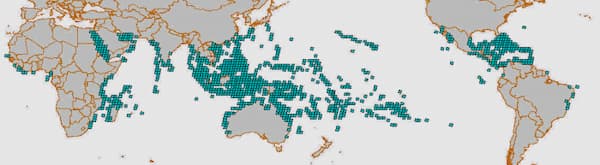
Global distribution of coral reefs. You can also check out this really cool Ocean Data Viewer on the global distribution of coral reefs. Both maps show that coral reefs are situated within the tropics.
Importance of Coral Reefs
Other than being great tourist attractions, coral reefs are home to a myriad of organisms (which is also a tourist attraction, heh) that is of importance to our livelihood, especially to coastal areas. Coral reefs are home to high biodiversity and high abundance of fish, crustaceans, mollusks, sponges, sharks and rays, echinoderms, planktons, macroalgae and etc. (apparently 25% of the ocean's biodiversity can be found in coral reefs)!

We can harvest/use these coral reef organisms for seafood (15 tonnes of seafood per km each year from properly managed coral reef), production or in production of many things (uses of seaweed), medical research (antibacterial activity in marine sponges), and they are tremendous carbon sinks, just like rainforests!

Coral reefs are important carbon sinks because they trap a lot of atmospheric carbon dioxide by creating their aragonite calcium carbonate exoskeleton. Atmospheric carbon dioxide enters the ocean everyday to form carbonic acid, which is made of a bicarbonate anion and a "free" hydrogen cation. The corals will use the bicarbonate anions and abundant calcium cations in seawater to form their calcium carbonate exoskeletons, which will then house all the other living things that we benefit from.

CO2 + H2 H2CO3
Ca2+ + 2HCO3--> CaCO3 + CO2 + H2O
Top: Chemical equation of atmospheric carbon dioxide reacting with seawater to form carbonic acid. Bottom: Chemical equation of the combination of calcium cations with the bicarbonate anions from the carbonic acid resulted from the reaction between atmospheric carbon dioxide and seawater.

Ocean Acidification on the Corals' Exoskeleton
You may think that the increase of atmospheric carbon dioxide (ie. from the combustion of fossil fuels) will benefit the corals and the other biota in the coral reef ecosystem because there will be more carbon dioxide available for the creation of calcium carbonate exoskeleton. The increase of carbon dioxide levels in seawater will decrease its pH (becomes more acidic, but not <7 acidic, just higher concentration of hydrogen cations), which can actually hinder the coral calcification process to build reefs; corals must then use more energy to form their exoskeleton. (Read this article for more in depth explanation with plenty of chemical oceanography jargon.)

Nevertheless, coral reefs remain an important carbon sink for now, and hopefully for many years to come.

There is still much to write about coral reefs, especially the threats they face in a period of increase human development and climate change. (The example on how the increase in acidity of seawater affects the calcification of corals is just one of the many, many threats faced by corals.) I guess I will just have to save that topic for another time.

I hope you enjoyed this entry. And like all the other entries in this blog, please let me know how I can improve in any way possible.

Enjoy the ocean responsibly!